
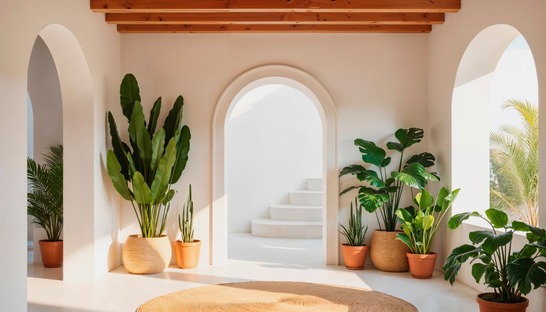
What happens when a passive wall and a living leaf share the desire to speak quietly together? This opens the door to the beginnings of earthy minimalism,” explains Brie Case of Green Blunt Design. Earthy minimalism as a style doesn’t shout to get noticed; however, it will linger long after leaving the building. This philosophy doesn’t strip life away from architecture. It refines architecture to the bare essence.
“Earthly Minimalism” is a term that is aptly realized through the concept of “restraint. Beige is the foundation built not by aggressive colours, but by the stillness of the soil after the rainfall of time. For architecture majors and discerning spectators, the resulting colours are a tutorial in restraint. A subtle background heightens the importance of each element. A texture, an edge of shadow, a beam of light becomes significant. Beige is not blank. It is waiting.
Into this calm enters botanical green. Not as decoration but as presence. Green reminds us that buildings are not isolated objects. They exist within landscapes, climates, and daily rituals. A plant placed with care can soften a corner, guide movement, or create pause. Green in earthy minimalism is never excessive. It feels intentional, as if nature has been invited rather than displayed.
This balance tells a story of coexistence. Architecture here does not dominate nature nor surrender to it. Instead, it listens. Beige surfaces reflect light softly while green elements absorb attention gently. Together they create interiors and spaces that feel grounded. For students of architecture, this approach teaches sensitivity. It asks you to design not just with form but with feeling.
Earthy minimalism also communicates through materials. Consider plaster walls, natural flooring, timber details, and living plants. These elements also grow more beautiful with age. These materials are accepting of weathering, natural change, and human interaction. In other words, it is sustainability. It is longevity and not fashion.
Think about how such a philosophy translates into experience. You are in a space and are feeling peaceful without quite knowing why. You are looking around slowly. You are relaxed. Such is the power of architecture presented in a subtle manner. It is storytelling without storytelling.
In order to learn more about this design language, you can ask yourself the following questions.
- How can beige surface textures be layered on top of each other without the use of colour contrast
- Where can botanical green support spatial flow rather than filling up empty corners
- How does natural light affect the dialogue of neutral walls and life components?
- Can fewer materials create a stronger emotional response
- What happens when a space is intended to age versus impress immediately
Earthy minimalism is not a formula. It is an attitude. It asks architects and students to slow down, observe nature, and design with humility. In merging beiges with botanical greens, we do not create silence. We create a soft conversation between the built and the living, one that continues long after the drawings are complete.