
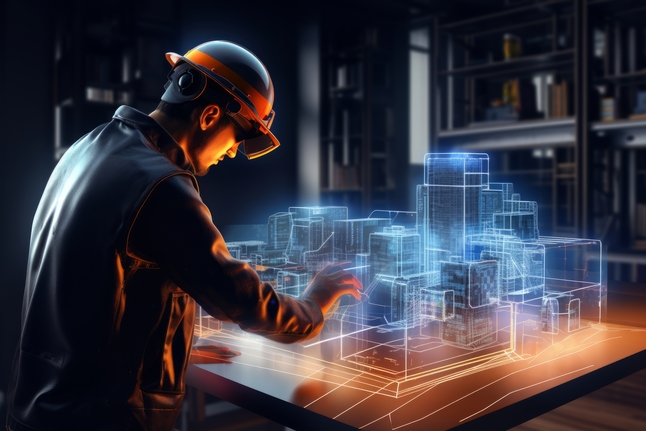
“The mother art is architecture. Without an architecture of our own, we have no soul of our own civilization.”
– Frank Lloyd Wright
Architecture has never been purely imagination or logic. From Renaissance hand-drawn sketches to modern-day computer models, it has developed alongside the instruments that craft it. Today, a new player is transforming the design process: Artificial Intelligence.
AI is no longer a buzzword for technology startups. It is walking onto building sites, infusing itself into design offices, and even co-creating architectural ideas. But where does AI belong in the world of architecture — a profession steeped in creativity, context, and culture?
Let’s delve into how AI is revolutionizing the architectural process and what this means for designers of the future.
The Beginning: From Drafting Boards to Algorithms
For generations, architecture has depended on human eyesight, instinct, and know-how. CAD made technical accuracy possible. Next came BIM, providing active models that could mimic actual building performance.
AI is the next step now — not merely a drawing tool but a system that learns, forecasts, and suggests.
Imagine telling a program your goals: energy efficiency, local materials, sunlight optimization, and urban flow. Instead of manually trying every option, the AI suggests multiple optimized layouts in seconds. It does not replace your vision — it expands it.
What AI Can Do for Architects
AI is not a replacement for creativity. It is a partner that accelerates and enhances it. Here’s how:
- Design Generation
AI can generate thousands of design variations based on parameters such as site conditions, zoning regulations, or sustainability goals. This enables architects to consider options they would never have thought of.
- Site Analysis
Computers can rapidly analyse topography, wind flow, sun exposure, traffic, and more. What used to take days of research takes minutes now.
- Sustainability Modelling
AI allows for simulation of energy consumption, daylighting, ventilation, and environmental effects — enabling architects to create smarter buildings in the beginning.
- Construction Optimization
AI enhances precision in schedules, material utilization, and structural analysis. It eliminates wastage, minimizes timelines, and avoids expensive mistakes.
- Personalized Architecture
By analysing user behaviour, AI can aid in creating spaces that adjust to certain requirements — whether it’s a smart house that gets familiar with your routine or an office that changes according to your staff.
What This Means for Architecture Students
As a student, AI might sound scary. You’d wonder, Will AI take the place of architects? The response is straightforward: No. But architects who employ AI will displace those who don’t.
To prepare for the future, consider:
- Learning AI-powered software such as Rhino with Grasshopper, Autodesk Forma, or Midjourney for conceptual investigations
- Knowing data — the more you learn about how buildings perform, the better you’ll be able to design
- Being curious — AI is changing rapidly, and so should you
- Balancing technology with humanity — AI can do math, but only you can design spaces that touch hearts and souls.
Architecture will never be free of the human touch. AI only makes that hand stronger.
Live Examples of AI in Architecture
Some innovative firms are already employing AI to challenge design limitations.
- Zaha Hadid Architects uses AI to create futuristic shapes reacting to environmental and spatial factors
- BIG (Bjarke Ingels Group) utilizes AI tools for site modeling and green city planning
- Spacemaker (now owned by Autodesk) assists architects in designing improved housing schemes through AI-based simulation
These companies aren’t leaving design behind. They’re augmenting it with tools that handle complexity quicker and smarter than ever.
The Future of AI in Architecture
In the future, we could see:
- Buildings that self-design based on real-time data
- AI collaborating in real-time with architects
- Cities designed by algorithms that forecast human action and environmental change
- Living spaces that expand, evolve, and learn with their inhabitants
But in the midst of it all, the architect is still the author. AI is a pen — but not the author.
Conclusion: Intelligence Meets Intuition
AI will not remove the soul of architecture. It will challenge us to define it more precisely.
As the tools get smarter, the work of the architect gets more profound. We need to ask better questions, think more integrally, and design with logic and love.
The future is not an either-or — man vs. machine. It is a partnership — a dialogue between creativity and computation.
If you are an architect, a student, or a design thinker, today is the day to get involved with AI. Not as a danger, but as a call to imagine bigger and design more.